
Roth IRA vs Brokerage Account: How to Choose
This content is for informational purposes only and isn't personalized financial, investment, tax, or legal advice. Consult a qualified professional before making financial decisions.
A Roth IRA and a regular brokerage account are not rivals. Most people end up using both, and the real question is which one gets the next dollar. The short answer: money meant for retirement usually goes into the Roth IRA first, up to the yearly limit, and everything else goes into the brokerage account. This article covers what each account does, the 2026 numbers that matter, and a simple order for splitting money between them.
A Roth IRA is an account type, not a different kind of broker
The confusion starts with the names. A Roth IRA is opened at a brokerage firm like Fidelity, Schwab or Vanguard, so in a literal sense it lives inside a brokerage. When people say "brokerage account," though, they almost always mean the plain taxable version at that same firm.
The investments are the same either way, since index funds, ETFs and individual stocks can sit in both. What changes is the tax wrapper around them, which is closer to a config flag than a different product.
What a Roth IRA does
Money goes in after tax, so there is no deduction this year. In return, growth is not taxed along the way, and qualified withdrawals are tax-free. The IRS Roth IRA page explains what counts as qualified. In general that means a withdrawal made after age 59½ and at least five years after the first Roth contribution.
There are limits, and they reset every year. For 2026 the contribution cap is $7,500, or $8,600 for anyone 50 and older, and it cannot exceed earned income for the year, according to the IRS announcement of the 2026 retirement limits. Room that goes unused cannot be made up later, which works a lot like a rate limit that does not carry over to the next window. Contributions for 2026 can be made until the tax filing deadline, typically April 15, 2027.
Income matters too. Per the same IRS announcement, direct Roth contributions phase out between $153,000 and $168,000 of modified adjusted gross income for single filers, and between $242,000 and $252,000 for married couples filing jointly. Developers with stock compensation can cross those lines, which is where workarounds like the backdoor Roth come up. That route has its own tax rules and deserves its own article.
Access is the other tradeoff. Contributions can be withdrawn at any time without tax or penalty, since they were taxed going in. Earnings are different, and pulling them out early usually costs tax plus a 10% penalty unless an exception applies. IRS Topic 557 lists those exceptions, and IRS Publication 590-B covers the Roth distribution rules in full.
What a regular brokerage account does
A taxable account has no contribution limit, no income limit and no age rule. Money can go in and come out whenever, which makes it the better home for goals that are closer than retirement, like a house down payment or a career break.
The cost is tax along the way. Dividends are taxed in the year they are paid, and selling at a gain creates a bill. Holding something for more than a year usually moves the gain into the long-term rates, which are 0%, 15% or 20% depending on income. For 2026, the 0% rate applies to taxable income up to $49,450 for single filers and $98,900 for joint filers, according to Experian's 2026 capital gains rate breakdown, which tracks IRS Revenue Procedure 2025-32. IRS Topic 409 explains how the rates and holding periods work.
One thing a taxable account can do that a Roth cannot is use losses. A realized loss can offset gains, with the wash sale rule blocking a repurchase of the same security within 30 days (IRS Publication 550 has the details). Inside a Roth IRA, a loss just stays a loss.
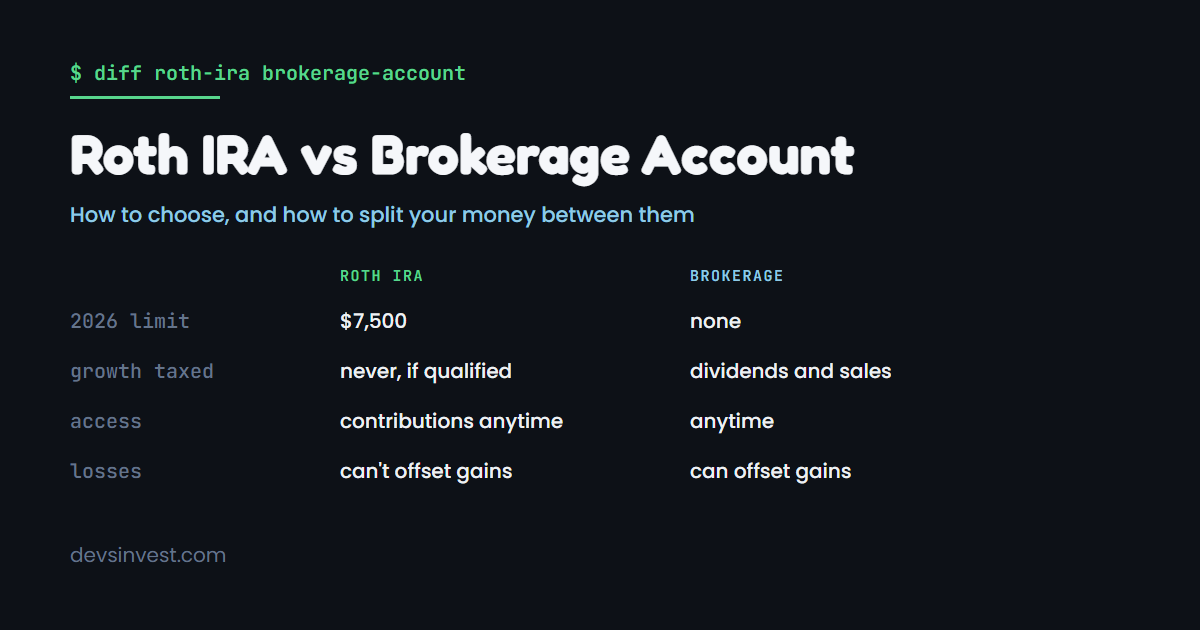
Roth IRA vs brokerage account at a glance
| Feature | Roth IRA | Brokerage account |
|---|---|---|
| Yearly contribution limit | $7,500 ($8,600 if 50 or older) | None |
| Income limit | Phases out at $153,000 to $168,000 (single) and $242,000 to $252,000 (joint) | None |
| Tax on growth | None while inside the account | Dividends taxed yearly, gains taxed when sold |
| Withdrawals | Contributions anytime. Earnings are tax-free once qualified (generally 59½ and five years) | Anytime, with tax on gains |
| Losses | Cannot be used to offset gains | Can offset gains |
| Usually fits | Long-term retirement money | Goals before retirement, plus anything beyond the Roth limit |
A simple order for splitting the money
No single ranking fits everyone, but the sequence below is a common starting point and tends to hold up for people early in their careers.
- Cover a basic emergency fund in cash and clear any high-interest debt first, because forced selling in a down market is expensive in either account.
- Capture any employer 401(k) match, since an immediate match is hard to beat with anything else.
- Fund the Roth IRA toward the yearly limit, if income allows it, for money that will not be touched for years.
- Send what is left to a taxable brokerage account.
A rough example makes the split concrete. Say $1,000 a month is available to invest, which is $12,000 a year. For someone under the income limits, a Roth IRA would absorb $7,500 of that, about $625 a month, and the remaining $4,500 would go to the brokerage account. The numbers are hypothetical and will move with income and goals.
Roth IRA or brokerage account: when the brokerage should come first
The Roth-first order assumes the money is for retirement. If a large purchase is planned in the next five years, the flexibility of a taxable account tends to matter more than the tax break, and keeping that money in cash or short-term holdings may fit better than the stock market anyway.
Developers with RSUs run into a second case. Vested shares land in a taxable account by default, and the Roth limit is too small to absorb a large vest. The practical work there is deciding how much company stock to hold, which is a concentration question more than an account question. A spreadsheet or script that totals holdings across accounts helps, and the portfolio tracking script covers one way to build it.
What to hold in each account
Choosing the account is one decision and choosing what goes inside it is another. A broad index fund works in either one, so the account choice alone does not force an investment choice.
Some people follow a rule of thumb called asset location. Holdings expected to grow the most tend to fit the Roth well, since that growth is never taxed, while a taxable account suits holdings that pay little in yearly dividends or interest. It is a refinement and not a requirement, and it adds complexity. Someone holding one broad index fund in each account gives up very little by skipping it.
Rebalancing is easier in the Roth for a plain reason: selling there creates no tax bill. In the taxable account, every rebalance is a potential taxable event, so new contributions are usually the cleaner way to nudge the mix back toward target.
Roth IRA vs brokerage account: common questions
Is a Roth IRA a brokerage account?
Not quite. A Roth IRA is a tax-advantaged account type, and it is opened at a brokerage firm. A "brokerage account" in everyday use means the regular taxable account at that same firm.
Can I have a Roth IRA and a brokerage account at the same time?
Yes. The two do not compete with each other. Many people fill the Roth IRA up to the yearly limit first and send anything beyond that to a taxable brokerage account.
Can I take money out of a Roth IRA before age 59½?
Contributions can come out at any time without tax or penalty, because they were taxed going in. Earnings are different: withdrawing them early usually triggers tax and a penalty unless an exception applies.
The short version
The tax-free growth in a Roth IRA is hard to replicate, so it makes sense to use the yearly room before it expires. The brokerage account picks up everything the Roth cannot hold, plus any money that might be needed before retirement. Using both, in that order, covers most situations without needing to pick a winner.