Signs Your Portfolio Has Technical Debt, and How to Refactor It
Technical debt doesn't only build up in a codebase. A portfolio picks up the same kind of debt over time: positions bought during a specific moment and never revisited, an allocation that drifted quietly away from the original plan, and decisions nobody wrote down the reasoning for. None of this is unusual, and it isn't a crisis on its own.
Left alone long enough, though, it starts costing real returns the same way an unrefactored codebase starts costing real engineering time. Here's what portfolio technical debt actually looks like, and a refactor process for paying it down.
What Portfolio Technical Debt Actually Looks Like
Technical debt in software is a shortcut taken under time pressure that works fine at first and gets expensive later. Portfolio debt follows the same shape.
For example, a handful of GME shares bought during the 2021 meme-stock craze and never touched since is the portfolio equivalent of a function nobody has opened since it shipped. It might still work. It also might be quietly costing more than it earns, and nobody's checked in years.
The parallel holds because both kinds of debt come from the same source: decisions made quickly, under pressure, with a plan to revisit them later. The revisit usually doesn't happen on its own, in code or in a portfolio. Someone has to schedule it.
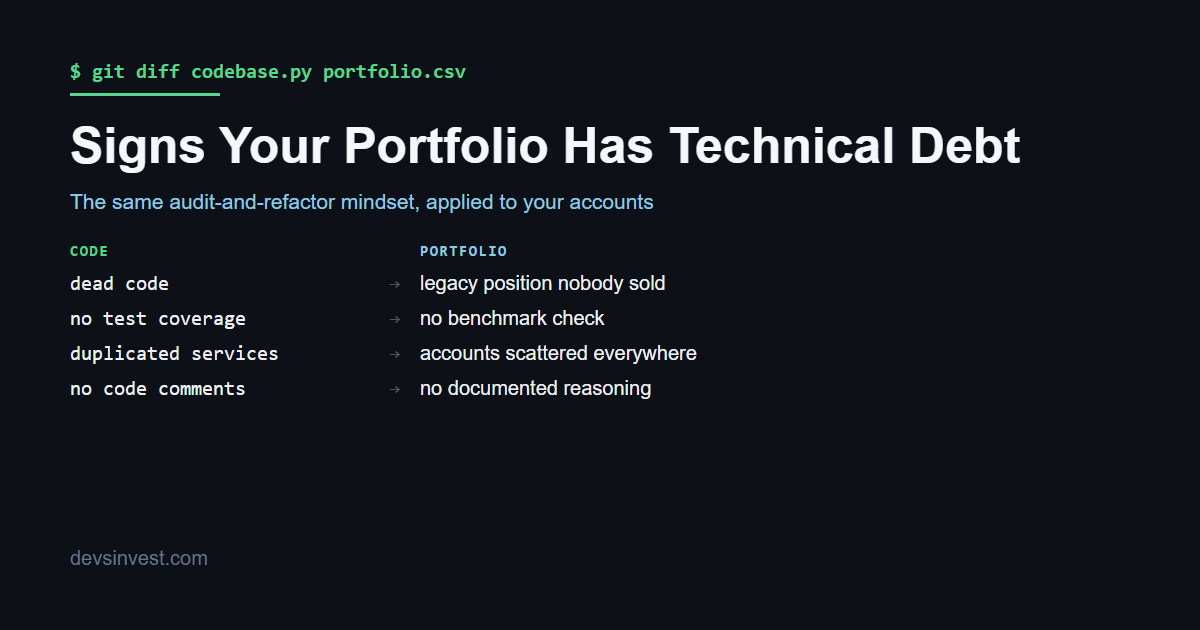
A few patterns show up often enough to check for directly.
Legacy positions nobody revisits
A stock or fund bought years ago sits in the account purely because selling it would trigger a decision nobody's made time for, not because it's still the right holding: ESPP shares from a job three roles back, or a single stock bought on a tip in 2019. Nobody deletes it, so it stays, and the reasons it was ever added get fuzzier every year.
No rebalancing cadence
The "120 minus age" rule of thumb puts a 27-year-old at roughly 93% stocks and 7% bonds. A few years of contributions weighted toward whatever felt safe that month, with nobody checking, and that ratio can drift several points off without anyone noticing. A system with no refactor cycle drifts the same way, moving further from its original design with every patch that works around the structure instead of updating it.
Holdings scattered across old accounts
A 401(k) from a few employers ago, a taxable account opened for one specific trade, a robo-advisor account tried once and forgotten: each one is a small, disconnected piece of the whole picture, the same way logic duplicated across three microservices with no shared library is harder to reason about than the same logic living in one place.
No documented reasoning
Ask why one stock makes up more of the account than any single fund, and the honest answer is often "not sure." The reasoning made sense to whoever bought it, and to nobody since.
Emergency fund mixed into the portfolio
Three to six months of expenses meant to cover a job loss or a broken car has no business sitting in the same brokerage account as long-term holdings. The two have different jobs and different time horizons, and mixing them means a bad month in the market can end up deciding whether the emergency fund is actually there when it's needed.
No benchmark check
Performance gets judged by a vague feeling ("it's been fine") instead of an actual comparison against something like VTI. There's no way to tell the difference between "fine" and "quietly underperforming" without checking.
How to Refactor a Portfolio Like You'd Refactor Code
Paying down this kind of debt doesn't need a dramatic overhaul, and treating it like one is usually what stops people from starting. The same incremental process used to refactor a codebase works here too.
Audit before changing anything
Before moving a single dollar, get a full, current view of every holding across every account. A quick Python script pulling live prices or a spreadsheet built around the GOOGLEFINANCE function can pull everything into one place instead of checking four different apps to piece it together.
Consolidate what's redundant
Rolling an old 401(k) from a previous employer into a single IRA isn't always the right move. If the old plan charges no maintenance fees and has a solid set of fund options, there's a genuine case for leaving it where it is.
But if the provider is an unfamiliar name with a clunky interface, the fund lineup is thin, or the plan keeps charging a small annual maintenance fee for an account nobody's contributing to anymore, that account is a candidate to move somewhere more reputable.
Set a rebalancing cadence and stick to it
Once or twice a year, check the actual allocation against the target and correct the drift. Treating this like a scheduled maintenance job that runs on its own cadence beats waiting for a market headline to prompt a reaction, since that timing has nothing to do with what the portfolio actually needs.
Document why each position is held
A short note next to each holding, something like "bought at $140 on the earnings dip, sell below $100 or if the thesis stops holding," does for a portfolio what a comment explaining a workaround does for code. It gives the next decision context instead of forcing a guess.
Check against a benchmark on a schedule
Comparing returns against something like VOO once or twice a year turns "it's been fine" into an actual answer. If a portfolio is underperforming a plain index fund consistently after accounting for its actual risk level, that's a real thing to understand, not something to ignore.
The Payoff
None of this requires predicting the market or picking better stocks. It takes the same discipline already familiar from maintaining a codebase: look at what's actually there, remove what's redundant, document what's left, and check the result against something real instead of a feeling.
A portfolio with less debt isn't necessarily one that returns more. It's one where every position is there on purpose, and that's a much easier thing to defend or hand off later.
This content is for informational purposes only and isn't personalized financial, investment, tax, or legal advice. Consult a qualified professional before making financial decisions.
← Back to DevsInvest